
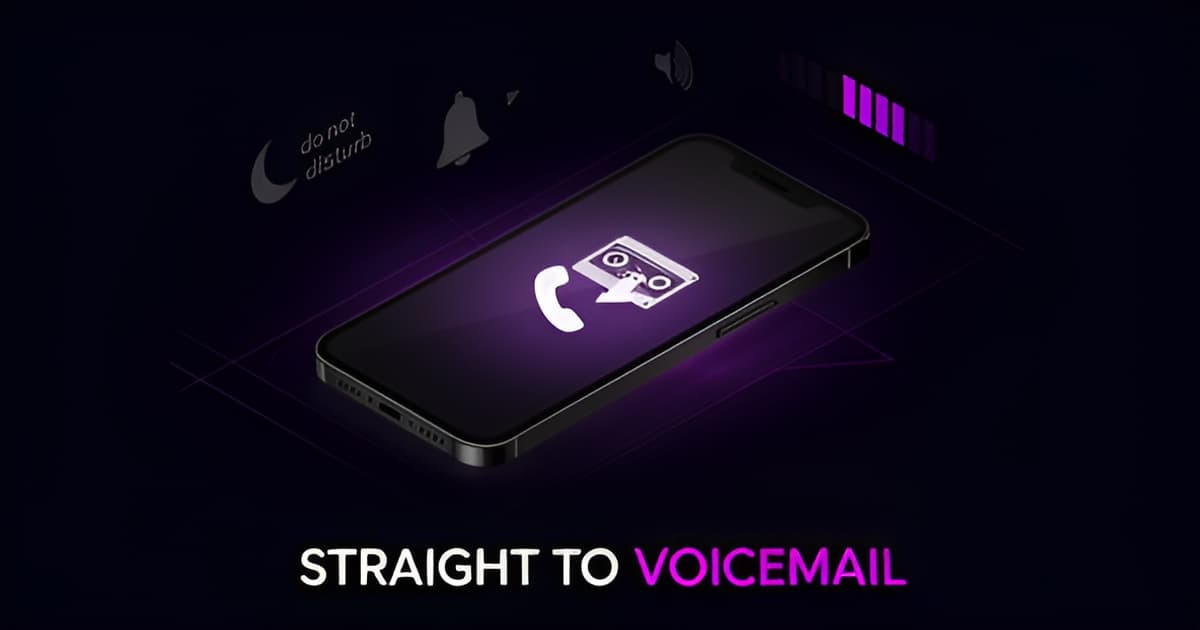
Why do all my outgoing calls go to voicemail?
Key Facts
- 86% of unknown calls go unanswered, according to Hiya's State of the Call report.
- A spam label can drop answer rates 20–50% overnight, per caller ID reputation research.
- Blocking apps make up to 20% of Samsung prospects unreachable, notes AWS outbound calling documentation.
- STIR/SHAKEN verifies calls are real but does not prevent Spam Likely labeling.
- Branded Caller ID lifts answer rates by 30%, according to AWS documentation on outbound calling.
- Healthy campaigns see 15–25% daily connection rates on fresh, consented lists, per answer-rate benchmarks.
- Multi-channel engagement outperforms single-channel by 70%, per AWS outbound calling guidance.
It's Not Your Script: Why Calls Are Dying Before They Ring
Your team rewrote the script twice, shortened it, warmed it up. Nothing changed. The calls still die before anyone hears a word, and the problem isn't what you're saying. It's whether the phone even rings.
According to industry data from Hiya's State of the Call report, 86% of unknown calls go unanswered. That number isn't a measure of how persuasive your opening line is. It reflects what happens before the first word: carriers and blocking apps like Hiya label your number "Spam Likely" or "Fraud Risk," and the recipient's phone silently routes the call to voicemail or blocks it entirely.
The damage happens fast. Research on caller ID reputation shows that once a number picks up a spam label, answer rates can drop 20–50% overnight. One day your connect rate looks normal. The next, nearly half your calls go straight to voicemail and your reps haven't changed a thing. As JustCall puts it, a dropping connect rate usually has nothing to do with how good your agents are.
Device-level screening makes it worse. AWS documentation on outbound calling notes that on certain devices, Samsung phones being a prime example, blocking apps can make up to 20% of prospects completely unreachable. Those contacts never see a missed call. There's no voicemail to check. From your side, they just don't answer.
You might assume that STIR/SHAKEN, the federal authentication framework, solves this. It doesn't. Authentication only verifies that a call is real and unspoofed. It doesn't decide whether the call shows up as "Spam Likely." That designation comes from analytics engines and reputation signals across carriers, which means a fully compliant, permissioned caller can still get flagged based on volume patterns or user reports.
The core culprits behind silent voicemail routing:
- Number burnout: reusing the same number for high-volume outbound campaigns erodes its reputation until carriers flag it.
- Carrier and app filtering: third-party blocking services and carrier-level screens intercept calls before they ring.
- List decay: stale or invalid numbers inflate your "no answer" counts and mask the real problem.
- Bad timing: calls outside the 10:00 AM to 5:00 PM window connect at significantly lower rates.
This is why number health has become a real-time operating discipline rather than a one-time check. A number that's clean today can be flagged tomorrow, and it can perform differently on one carrier than another. Managed outbound services like My AI Call Center treat this as part of campaign monitoring, watching outcomes in real time so a flagged number gets caught and swapped before it quietly destroys a week of calling. The fix, as AWS notes, is usually fast: switching to a new, registered number restores connectivity. But you have to know the flag happened, and most teams find out only after the damage shows up in their reports.
The Four System Failures Behind Low Connect Rates
If your connect rate has cratered and every dial lands in voicemail, the problem usually isn't your script or your team's effort. It's four mechanical failures working against you before the phone ever rings.
1. Number burnout. Reusing the same caller ID for high-volume outbound campaigns wears out the number. Carriers and analytics engines flag it as "Spam Likely," and once that label sticks, answer rates can drop 20–50% overnight, according to industry benchmarks on caller ID reputation. STIR/SHAKEN authentication won't save you here. It only verifies the call is real; the spam label comes from reputation signals and user reports, so even fully permissioned calls can get flagged.
2. Device-level blocking. Some of your prospects never see the call at all. Blocking apps and carrier filters can make up to 20% of prospects unreachable on specific devices like Samsung phones, per AWS's outbound calling documentation. That's a fifth of your list gone before timing or messaging even matters. It's why 86% of unknown calls go unanswered across the industry, and why 74% of decision-makers told Forrester their right-party contact rate falls short of good.
3. Bad timing. Calls placed outside the 10:00 AM to 5:00 PM window, or without adjusting for the prospect's local time zone, connect at significantly lower rates. Dialing at 8:15 AM or 6:30 PM feels like an intrusion, and unanswered dials train recipients to ignore your number next time. Reusing the same number repeatedly is described in the AWS guidance as a sure way to annoy customers and depress answer rates.
4. Stale lists. If more than 0.5% of your calls fail on invalid numbers, the guidance is clear: your list needs maintenance before anything else matters. Disconnected and wrong numbers inflate your cost per conversation and poison your outcome reporting, because every failed dial gets logged alongside real "no answers" and skews what you think is happening.
Here's the takeaway: connection rate is a systems metric, not an effort metric. On fresh, consented lists with healthy numbers, a realistic baseline is 15–25% daily connection rates. Poor reputation can push that into single digits, no matter how many reps you throw at the phone. That's why we check list source, consent records, and calling windows before any My AI Call Center campaign launches, and monitor outcomes in real time once calls are running. If the list won't support the campaign, you should know before you spend anything.
- Burned-out caller IDs: swap flagged numbers fast, since a new number is typically the quickest way to restore connectivity.
- Device and carrier blocking: expect a share of prospects to be unreachable and measure against a healthy baseline, not perfection.
- Timing: stay inside 10 AM to 5 PM local time, every time.
- List hygiene: validate numbers before launch and act when invalid-dial failures cross 0.5%.
Fix the system, and the voicemails start turning into conversations.
Fixing It: Number Rotation, Branded ID, and Pre-Call SMS
If your calls keep landing in voicemail, the good news is that the fixes are mechanical, not mysterious. You don't need a better script. You need better number hygiene, context before the ring, and smarter timing.
Start with dynamic number rotation. When a number gets flagged, answer rates can drop 20–50% overnight, according to research on caller ID reputation. AWS's own guidance is blunt: switching to a new number is typically the fastest way to restore connectivity once your caller ID has been flagged. The catch is that static checks don't work anymore. Number health varies by carrier and changes quickly, so the numbers you dial from need continuous, real-time monitoring, with unhealthy DIDs retired before they drag your campaign down.
Branded Caller ID is the second lever. Displaying your actual business name instead of a bare number builds trust before anyone answers. AWS documentation reports a 30% answer-rate lift from branded calling, and it reduces the odds your call gets mistaken for spam. Remember that STIR/SHAKEN authentication only proves the call is real; it doesn't stop the "Spam Likely" label, which comes from carrier analytics engines. Branding your identity closes that gap.
Pre-call SMS gives context before the phone rings. A short text announcing who's calling and why primes the recipient, and it works: multi-channel engagement outperforms single-channel approaches by 70% on average. For structured campaigns, like appointment reminders or renewal calls, a quick "we'll call you tomorrow at 2 PM about your booking" turns an unknown number into an expected one.
Your remediation playbook, in order of speed:
- Rotate flagged numbers immediately and monitor carrier-level health in real time, not weekly.
- Enable Branded Caller ID wherever the carrier supports it.
- Send a pre-call SMS so the recipient knows who's calling and why.
- Dial within the 10:00 AM to 5:00 PM window, adjusted for each recipient's time zone.
- Use local presence numbers that match the recipient's area code.
That last two points matter more than people think. Calling outside the 10-to-5 window or in the wrong time zone is a documented cause of non-answers, and a local area code consistently outperforms a toll-free or out-of-state number. At My AI Call Center, every campaign runs inside approved calling windows with these disciplines built in, because answer rate is the metric that determines whether the rest of your campaign math works at all. As one industry analysis put it, when reps call at the right time from the right number, more dials turn into live conversations instead of voicemails.
Running Calls That Actually Connect: A Practical Checklist
Knowing why calls hit voicemail only helps if you turn it into a routine. Here's a checklist that keeps your campaigns connecting instead of drifting into single-digit answer rates.
Before launch: validate and permission-check the list. If more than 0.5% of your calls fail because of invalid numbers, your list needs maintenance, per AWS guidance on outbound calling. Stale numbers inflate your cost per conversation and make your reporting look worse than it is. Check list source and consent records before dialing, and flag any list without clear permission history. A bought list with no consent trail usually won't support the campaign at all.
Set expectations you can actually hit. A realistic baseline is 15–25% daily contact rates on fresh, consented lists dialed from healthy numbers, according to answer-rate benchmarks. If your number gets a spam label, that can drop 20–50% overnight. So don't panic at voicemail rates below 100%; panic at rates that fall outside the healthy band.
Watch dispositions in real time. Your outcome report should break every attempt into disposition codes: confirmed, no answer, voicemail, opted out. When no-answer and voicemail codes spike mid-campaign, that's your early warning that a number is burning out or a calling window is off. As call-center analytics guidance puts it, dropping connect rates usually trace back to stale lists or a flagged caller ID, not to how good your agents are.
Your running checklist:
- Validate numbers and confirm consent records before any campaign launches.
- Dial inside approved windows, roughly 10:00 AM to 5:00 PM in the contact's local time zone.
- Monitor disposition codes daily and retire numbers showing spam flags.
- Route follow-ups across channels: a pre-call text, then the call, then email if needed.
That last point matters more than most teams realize. Pre-call SMS announcing who's calling and when is explicitly recommended to raise answer rates, and multi-channel engagement outperforms single-channel by 70% on average.
This is essentially how managed campaigns are structured. My AI Call Center, for example, reviews list source, consent records, and calling windows before launch, runs calls only in approved windows, and reports outcomes with disposition codes in real time so you can see no-answer and voicemail trends as they happen, not after the campaign ends. Follow-ups route back across calls, texts, and emails, with opt-outs logged and honored immediately.
Run the routine every campaign, and voicemail stops being a mystery. It becomes a signal you read and act on.
When to Get Help With Your Calling Program
There's a point where more script tweaks and better timing stop moving the needle. If your connection rates sit in the single digits on a list you know is consented and current, the problem is almost certainly your number health and monitoring stack. A industry benchmark analysis puts a healthy daily connection rate at 15-25% on fresh, consented lists with clean numbers. Below that, something is broken at the infrastructure level.
The research is blunt about why. A spam labeling event can drop answer rates 20-50% overnight, and carrier documentation notes that on some devices, blocking apps make up to 20% of prospects unreachable no matter how good your list is. These are stack problems, and they need a stack-level review.
So what does that review actually look like? At My AI Call Center, every campaign starts with a structured review before anything launches:
- List source: where the numbers came from and whether permission records actually support the campaign.
- Consent records: documented prior express consent, especially important since AI-generated voices are treated as artificial voices under the TCPA.
- Calling windows: timing held to approved windows, adjusted for the contact's time zone.
- One clear goal: a single outcome per campaign, so results are measurable and honest.
This matters because a campaign with a weak list foundation will fail regardless of dialing technology. Bought lists without clear permission records get flagged, and in most cases declined. It's better to hear that before you spend anything than after.
The review also covers the technical side: number health, reputation monitoring, and rotation. If your caller ID has been flagged, AWS guidance notes that switching to a new number is typically the fastest way to restore connectivity. A managed review checks whether your numbers are burning out and builds rotation in from the start, rather than discovering it mid-campaign when connection rates crater.
If you're weighing whether to bring in help, the pricing should be plain before you commit. Calling starts at 9¢ per connected minute, tiered by volume, with the rate locked for the campaign. Most campaigns add a one-time setup and a flat monthly management fee, both quoted before launch. No per-seat charges, no platform bill, and no minimums you didn't choose. The first campaign review is free, so you know the full number before approving anything.
That's the decision point in plain terms: if your lists are consented and your connection rates are still stuck in single digits, the gap is in number health and monitoring. A structured campaign review will tell you whether the fix is rotation, timing, list hygiene, or something else entirely, and it costs nothing to find out.
Frequently Asked Questions
Why do all my outgoing calls go straight to voicemail?
Doesn't STIR/SHAKEN stop my calls from being labeled spam?
How do I fix a caller ID that's been flagged as spam?
What's a normal answer or connection rate for outbound calling campaigns?
Does the time of day I call really affect whether people answer?
When should I stop tweaking my script and get help with my calling program?
Voicemail Isn't a Verdict, It's a Signal
When every call lands in voicemail, the problem is almost never your script or your team's effort. It's the system underneath: a burned-out number flagged as spam, carrier and device-level blocking that makes some prospects unreachable, dialing outside the 10-to-5 window, or a stale list inflating your no-answer counts. A single spam label can drop answer rates 20–50% overnight, per research on caller ID reputation, while a healthy baseline sits at 15–25% on fresh, consented lists. The fixes are mechanical: rotate flagged numbers fast, brand your caller ID, send a pre-call text, dial in the right window, and validate your list before launch. Treat number health as a real-time discipline, not a quarterly check. This is exactly how My AI Call Center runs campaigns, list and consent review before launch, real-time disposition monitoring, and honest outcome reporting with no invented numbers. If your connect rates are stuck in single digits on a list you trust, the first campaign review is free, and you'll know the full picture before approving anything.