
How to prepare for a campaign?
Key Facts
- TCPA statutory damages run $500 per negligent violation and $1,500 per willful violation, counted per call per recipient according to compliance analysis.
- A 10,000-contact campaign with one broken consent parameter can mean $5M to $15M in theoretical exposure before legal fees.
- B2B contact data decays roughly 2.1% per month, meaning a year-old list can carry over 22% invalid entries before your first dial.
- The FTC mandates DNC scrubbing at least every 31 days because the National Registry updates continuously per compliance guidance.
- Consent records must be retained at least five years, one year longer than the TCPA's four-year statute of limitations according to legal analysis.
- As of April 11, 2025, businesses have only 10 business days to honor opt-out requests, down from the previous 30-day buffer per regulatory updates.
- Florida caps telemarketing calls at 8 p.m., New York requires opt-out within three seconds, and Oregon limits calls to three per consumer per day across divergent state rules.
The Preparation Gap That Sinks Campaigns Before Launch
When a campaign goes wrong, the script is rarely the reason. The damage almost always traces back to two things that never made it onto anyone's launch checklist: an unverified contact list and consent records that can't survive a courtroom.
The stakes are concrete. TCPA statutory damages run $500 per negligent violation and $1,500 per willful violation, counted per call, per recipient, with no aggregate cap and a four-year statute of limitations. One industry analysis put the theoretical exposure of a 10,000-contact campaign with a broken consent parameter at $5M to $15M before legal fees.
And the rules keep moving. The FCC's one-to-one consent rule was vacated in January 2025 and formally removed in July 2025, while at least a dozen states have passed their own telemarketing statutes since 2021. If you're calibrating only to the federal rulebook, you're calibrating to the loosest, least certain layer of the stack.
AI voices add another layer. Under the FCC's February 2024 Declaratory Ruling, AI-generated voices are treated as artificial voices under the TCPA, which means they require the same prior express consent as traditional prerecorded calls. A campaign that sounds modern is still judged by rules written for robocalls.
Then there's decay. B2B contact data goes stale at roughly 2.1% per month, or about 22.5% annually. A list you verified a year ago could carry a 22% invalid contact rate before your first dial. DNC scrubbing has the same problem: the FTC requires scrubbing at least every 31 days because the National DNC Registry updates continuously. A one-time pre-launch scrub is already out of date by the time you launch.
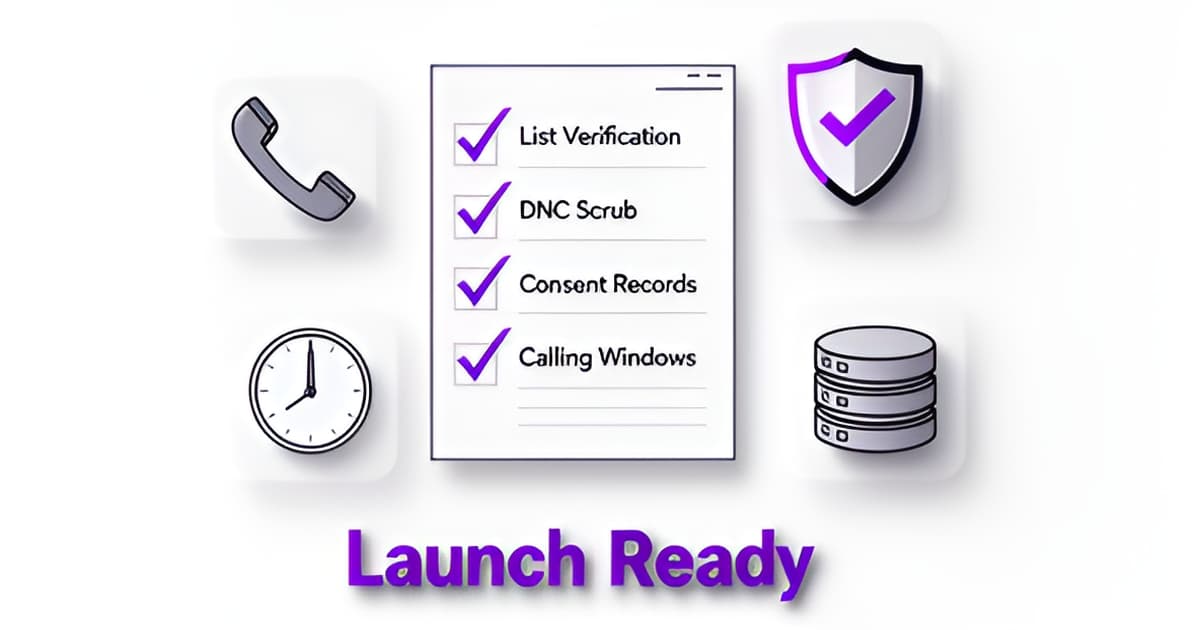
Before any list supports a campaign, it should clear a few gates:
- Consent captured as a timestamped data event: specific seller, specific channel, compliant language, and no later revocation. Most CRM consent records fail at least one of these.
- Records showing how and when consent was obtained, retained at least five years, since the TCPA statute of limitations runs four.
- A DNC scrub dated within 31 days of launch, not "done once, some time ago."
- Calling windows and frequency caps matched to the recipient's actual location. Florida caps calls at 8 p.m. versus the federal 9 p.m., and New York requires an opt-out opportunity within three seconds of a call's start.
This is why list discipline sits at the front of the process at My AI Call Center. List source, consent records, and calling windows are reviewed before anything launches, and bought lists without clear permission records get flagged, and in most cases declined. It's better to hear "this list won't support the campaign" before you spend anything than to learn it from a plaintiff's attorney.
One caveat worth stating plainly: requirements vary by location, industry, and contact type, and you're responsible for getting appropriate legal guidance before launch. Preparation isn't paperwork. It's the difference between a campaign and a liability.
What a Prepared Campaign Actually Requires
Most campaigns fail before the first dial. The problem usually isn't the script or the AI voice. It is the foundation underneath the list. If your consent records are vague, your data is stale, or your calling windows ignore state laws, you are building exposure, not a campaign.
A prepared campaign starts with one clear goal. You define the specific outcome you need from each call before touching the technology. This focus prevents scope creep and ensures the script actually serves the business need.
Next, you verify the list source. You cannot call a number if you cannot prove how you got it. Vague sourcing methods or missing permission records are immediate red flags. In many cases, these lists must be declined entirely to avoid legal risk.
Consent documentation is the second pillar. It is not just a checkbox; it is a legal record. Courts view consent as a timestamped data event, not a static document. Your records must capture four specific elements to stand up in court:
- The specific seller who obtained the consent.
- The specific channel used (e.g., phone, email, web form).
- Compliant language that clearly authorizes the call.
- Proof that no subsequent revocation has occurred.
If any of these elements are missing, the record is weak. You need to know exactly how and when consent was obtained. These records must be retained for at least five years, matching the statute of limitations for many violations.
Data decay is a silent killer. Contact lists lose validity over time. Research indicates that B2B data decays by approximately 2.1% per month, meaning a year-old list could have over 20% invalid entries. Industry analysis confirms this rapid decline in contact accuracy.
You must also scrub the Do Not Call registry on a strict cadence. The FTC mandates this scrub at least every 31 days. A pre-launch scrub is not enough. The registry updates continuously, so your suppression list must be current on the day the campaign runs.
Finally, calibrate your calling windows to the recipient’s actual location. Do not rely on area codes or federal defaults. State laws vary significantly. For example, Florida caps calls at 8 p.m., while Oregon narrows the window to 8 a.m. to 8 p.m. Compliance reporting highlights that a number’s area code does not dictate its legal constraints.
My AI Call Center reviews these elements before launch. We check the list source, verify consent records, and confirm calling windows match the recipient’s location. If the list cannot support the campaign, we tell you plainly before you spend anything. This discipline protects your brand and ensures every call is compliant.
A Pre-Launch Checklist for List Verification and Consent Records
Before a single call goes out, you need to know exactly who is on the list and why they are there. List verification and consent documentation are the two gates that decide whether a campaign can launch at all.
Start with the source. Confirm where each list came from and the relationship behind it, because bought lists without clear permission records get flagged and, in most cases, declined. Vendors who answer sourcing questions with vague references to "proprietary methods" or refuse to provide consent documentation are a disqualifying signal, according to guidance on list vetting. Ask for sample consent records before you buy anything.
Then check the consent itself. Courts treat consent as a timestamped data event, not a spreadsheet entry, and they look for four elements: the specific seller, the specific channel, compliant language, and no subsequent revocation. Most CRM-based consent records fail at least one of these, per TCPA compliance analysis. Store records for at least five years, since the TCPA statute of limitations runs four years.
Document the scrub date. DNC scrubbing must happen at least every 31 days, and the National DNC Registry updates continuously, so a one-time pre-launch scrub is not enough. B2B contact data decays roughly 2.1% per month, which means a 12-month-old list can carry a 22% or higher invalid contact rate before you dial once.
Enforce windows and caps per state, not by area code:
- Florida caps telemarketing calls at 8 p.m. local time instead of the federal 9 p.m.
- Oregon narrows the window to 8 a.m.–8 p.m. and limits calls to three per consumer per day.
- Oklahoma caps commercial solicitation at three calls per 24-hour period.
- New York requires an opt-out opportunity within three seconds of a call's start.
A 305 number can belong to someone who has since moved to a state with a tighter rule, so verify recipient location independently during list review.
This is the discipline My AI Call Center builds into every campaign review: list source, consent records, and calling windows checked before launch, and opt-outs logged and honored immediately. If the list will not support the campaign, you hear it plainly before you spend anything.
Running the Campaign Without Creating New Exposure
Launch day is where most campaigns stop thinking about compliance, and that's exactly where exposure gets created. The work you did on list verification and consent documentation before launch has to keep running after the first dial fires.
The single biggest discipline is opt-out handling. As of April 11, 2025, consumers can revoke consent by any reasonable means, including voicemails, in-conversation statements, and even informal social media messages, and businesses have only 10 business days to remove them, down from the old 30-day buffer. The smarter posture is to honor revocations immediately and across every channel, regardless of what the deadline allows, because that's the conduct a plaintiff's attorney will hold up in court.
That means logging DNC requests into the client's records, not just the campaign's. A transcript that logs an opt-out is a document, not a suppression event, as one compliance analysis puts it. At My AI Call Center, opt-outs are honored immediately and carried into client DNC records so the suppression survives past any single campaign.
Before you scale, run a pilot. A structured setup framework recommends piloting before full rollout, and the reasoning is simple: a small batch surfaces script problems, window violations, and bad list segments while the blast radius is small. TCPA statutory damages run $500 per negligent violation and $1,500 per willful one, counted per call per recipient, so a 10,000-contact campaign with one broken consent parameter can represent $5M to $15M in theoretical exposure. You want to find that parameter at 500 contacts, not 10,000.
Your post-launch routine should cover four things:
- Re-scrub against the DNC Registry on a 31-day cadence, since the registry updates continuously and a pre-launch scrub goes stale.
- Honor every opt-out immediately across calls, texts, and emails, and log it as a suppression event with a timestamp.
- Review dispositions daily during the pilot: confirmed, qualified, opted out, no answer, and follow-up requests.
- Route outcomes back into your CRM so the next campaign starts from clean, current data.
That last step matters more than people expect. B2B contact data decays roughly 2.1% per month, about 22.5% a year, so a list that sat untouched since your last campaign is already wrong in places. When opt-outs, dispositions, and follow-up requests flow back into the systems you already run, your next launch inherits a cleaner list and a documented consent trail instead of starting from scratch. The campaign ends; the discipline shouldn't.
Frequently Asked Questions
What actually causes outbound calling campaigns to fail before launch?
How much legal exposure can a broken consent record actually create?
Do AI-generated voices need the same consent as traditional robocalls?
How often do I really need to scrub the DNC Registry?
How quickly do contact lists go bad, and what does that mean for an old list?
What should I look for in a list vendor before I buy?
Launch With Confidence, Not Liability
Preparation is the difference between a successful campaign and a legal liability. The data is clear: lists decay rapidly, and consent records must withstand strict scrutiny to survive a lawsuit. If your current list sourcing lacks clear permission trails or your consent records miss required elements, you are building exposure, not a campaign. The most effective next step is to audit your current contact lists against the four pillars of compliance: verified source, timestamped consent, recent DNC scrubbing, and location-specific calling windows. This discipline ensures that every call you make is authorized and defensible. At My AI Call Center, we build this review into every campaign, checking list sources and consent records before launch. If a list cannot support your goal, we tell you plainly before you spend anything. We run structured, AI-powered calling campaigns that confirm, qualify, and connect, starting at 9¢ per connected minute. Compliance analysis shows that the cost of a single violation can dwarf the value of an entire campaign. Don’t let a broken consent parameter sink your launch. Review your list discipline today, and ensure your next campaign is built on a foundation that holds up in court. Your business deserves calls that work, without the risk of unintended consequences.